
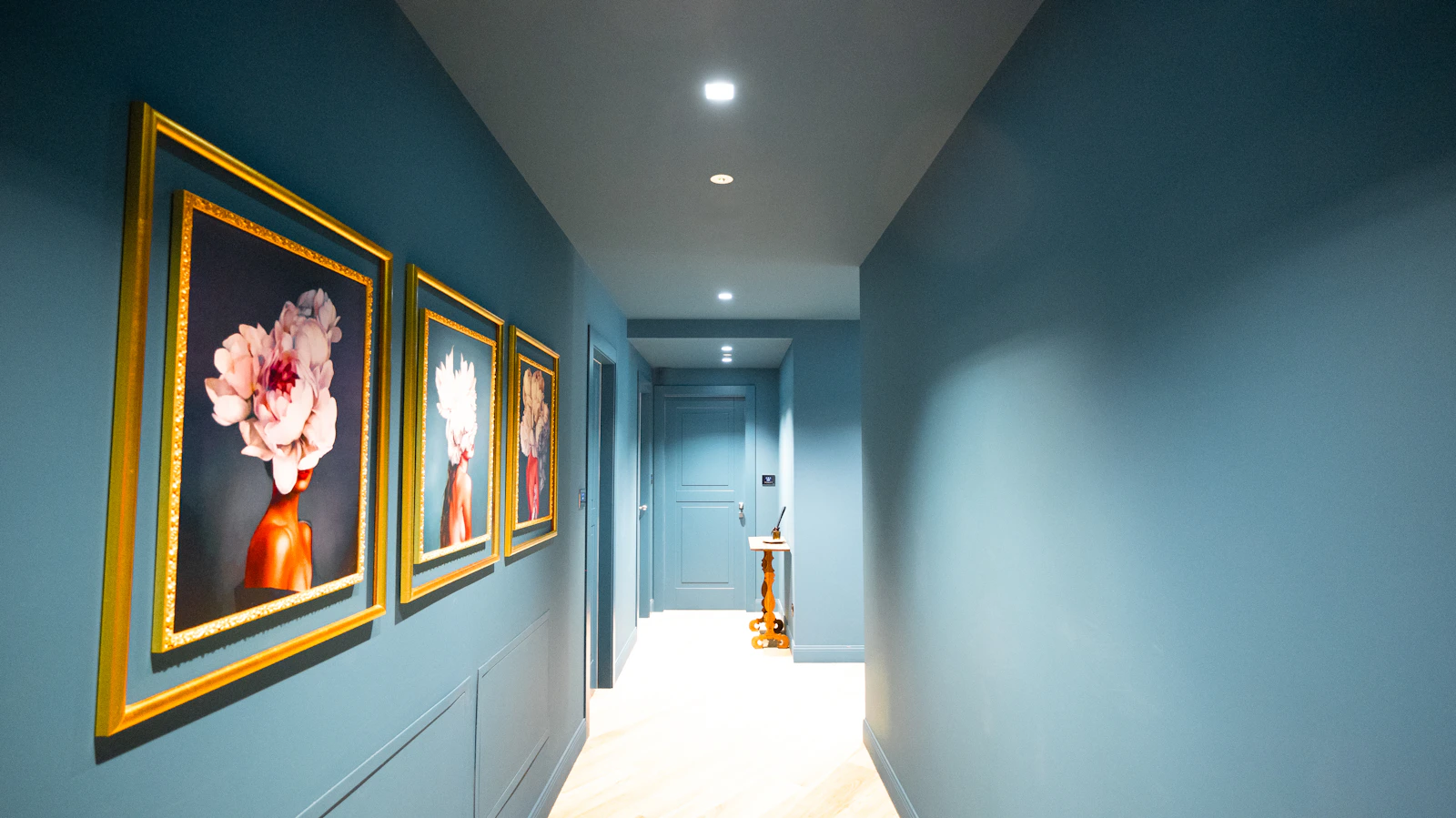
Why Boutique Hotel Corridor Design Deserves Your Full Attention
Ask any seasoned hospitality designer where guests form their most lasting impressions, and the answer may surprise you: it's not the lobby, not the restaurant, and not even the guest room itself. It's the corridor — that transitional passage guests traverse multiple times a day, often alone, always at close range with the walls, floors, and finishes that define your property's character. In boutique hotel corridor design, every square meter is a curated touchpoint, and the materials you choose determine whether a guest feels like they've entered something extraordinary or simply walked through another hallway.
In the Philippine hospitality market, where boutique properties compete fiercely against international chains and lifestyle resorts, this distinction matters enormously. A corridor that communicates design intentionality — through texture, color, material depth, and seamless continuity — signals to guests that they are in a space where every detail has been considered. That signal is worth real money. Research consistently shows that guests are willing to pay a premium of 20–30% more per night for boutique properties that deliver on a coherent, immersive aesthetic experience. The corridor is where that promise is either kept or quietly broken.
The Problem with Conventional Corridor Finishes
Most commercial corridors — even in properties that invest heavily in lobbies and suites — default to predictable, utilitarian finishes: flat painted drywall, ceramic tile flooring with visible grout lines, and drop ceilings that compress the sense of vertical space. These choices are understandable from a cost and maintenance perspective, but they carry a significant hidden cost: they flatten the guest experience at precisely the moment when the property could be reinforcing its brand narrative.
For boutique hotels in particular, where the entire value proposition rests on uniqueness and atmosphere, a generic corridor undermines everything the property is trying to communicate. Grout lines break visual continuity. Painted walls chip, stain, and yellow. Standard tile reflects sound harshly, amplifying noise that should feel muted and private. These are not minor aesthetic grievances — they are sensory cues that subconsciously signal to guests that the property's commitment to quality has limits.
The High-Traffic Challenge
Corridors in commercial hospitality environments absorb extraordinary punishment. Luggage wheels, housekeeping carts, food trolleys, and thousands of footfalls per week test flooring systems in ways that few other interior environments do. This is why the material specification for hotel passages must solve two problems simultaneously: it must be visually stunning and operationally durable. Premium decorative coatings have matured to the point where these two requirements no longer exist in tension.
Seamless Floor Finishes: The Foundation of Corridor Luxury
One of the most transformative decisions a designer can make in boutique hotel corridor design is the elimination of grout lines from the floor plane. Grout lines do several things that work against the luxury experience: they interrupt visual flow, they collect grime, they require constant maintenance, and they make a space feel assembled rather than crafted. Seamless flooring systems solve all of these problems at once.
Microcement is one of the most sophisticated tools available for achieving this effect in hospitality interiors. This trowel-applied coating bonds directly to existing substrates and cures into a continuous, monolithic surface that reads as a single unbroken plane. Available in both Coarse and Fine textures, microcement can be calibrated to suit the specific aesthetic of a corridor — a Fine texture delivering a refined, almost polished quality for luxury urban boutique hotels, while a Coarse texture introduces tactile warmth appropriate for resort or heritage properties.
Beyond aesthetics, microcement performs exceptionally well under the mechanical stress of hotel corridor traffic. When properly sealed, it resists staining, handles wheeled loads without marking, and is far easier to spot-repair than tile or stone. For designers and developers working on commercial flooring applications, this combination of visual continuity and practical resilience makes it one of the most compelling specifications available in the Philippine market today.
Extending the Language of the Floor to the Wall Base
One technique that consistently elevates corridor design is the continuous application of the same material across the floor plane and up a portion of the wall — typically as a skirting or dado treatment. When microcement flows seamlessly from floor to wall base without a transition strip or grout line, it creates a sense of material integrity that reads immediately as premium. This is a detail that guests may not consciously identify, but they feel it: the space seems more resolved, more intentional, more expensive.
Decorative Wall Coatings: Where Brand Identity Becomes Tactile
If the floor establishes continuity, the walls of a boutique hotel corridor are where personality lives. This is the canvas for texture, tone, and the kind of surface depth that invites guests to slow down and engage — even briefly — with their surroundings. Decorative wall coatings for hospitality applications have advanced dramatically, and the best products available today offer designers a level of creative control that was previously only achievable with rare or expensive natural materials.
For boutique hotels positioned at the luxury end of the market — think intimate heritage properties in Intramuros, design-forward resorts in Siargao, or lifestyle hotels in BGC — Liquid Polish offers a wall finish unlike anything achievable with conventional paint or plaster. This Venetian plaster-style coating builds up in thin, translucent layers that are hand-troweled and burnished to a mirror-like sheen. The result is a wall surface with genuine optical depth: light moves across it differently throughout the day, and the finish catches and holds the eye in a way that flat or matte surfaces simply cannot.
In a corridor context, Liquid Polish is particularly effective as a feature treatment on a single wall or on recessed alcoves between room entry doors. Rather than running the high-gloss finish on every surface — which can feel overwhelming in a narrow passage — designers use it strategically to punctuate the journey down the corridor and create moments of visual arrival. Combined with well-placed directional lighting, a burnished Liquid Polish wall transforms an otherwise unremarkable stretch of passage into something that guests photograph and remember.
Texture as Wayfinding and Brand Language
Sophisticated hospitality designers increasingly use surface texture not just decoratively, but functionally — as a form of soft wayfinding that guides guests through a property without the intrusion of signage. A corridor wall that shifts from a smooth, polished finish near the elevator lobby to a warmer, more textured treatment near room entries creates a subliminal transition between public and private zones. This kind of material storytelling is one of the defining characteristics of world-class boutique hotel corridor design, and it is now entirely achievable with the decorative coating systems available in the Philippine market.
Facade and Entry Passage Design: The First Impression Before the First Impression
The corridor experience often begins before guests even enter the building. Covered walkways, porte-cochères, and semi-outdoor passage areas that connect parking or garden spaces to the main entrance are extensions of the corridor narrative — and they demand materials that perform in Philippine climate conditions, where heat, humidity, and UV exposure are relentless.
For exterior-facing passage walls and columns, sintered mineral coatings designed for vertical facades bring the same aesthetic intentionality as interior decorative systems, but with the weather resistance that outdoor environments demand. Opus, TechStone's sintered sand and polished concrete-look coating, is engineered for exactly these conditions — delivering the natural stone aesthetic that boutique hotel designers frequently specify, on surfaces that see direct sun, rain, and the full intensity of tropical weather. Applied to the boundary walls and covered passage columns of a boutique resort property, Opus creates a material continuity between landscape and interior that makes the entire arrival sequence feel cohesive and considered.
Designing Corridors for the Philippine Boutique Market
The Philippine boutique hotel sector is in a period of genuine creative maturation. Properties across the archipelago — from the heritage districts of Vigan and Cebu to the emerging lifestyle hospitality scene in Palawan and Batangas — are increasingly competing on design quality rather than room count or star rating alone. For these properties, the corridor is not a back-of-house afterthought but a primary design asset.
Several principles consistently emerge from successful boutique hotel corridor projects in this market:
- Material continuity over variety: The most effective corridors use a limited palette of materials applied consistently, rather than mixing multiple finishes that compete for attention. A seamless microcement floor paired with a single premium wall coating reads as more luxurious than five different materials used in the same space.
- Lighting and material collaboration: Decorative coatings only perform at their best when the lighting specification is designed in parallel. Textured and polished surfaces respond differently to ambient versus directional light — and the most memorable corridor experiences result from lighting designers and material specifiers working from the same brief.
- Acoustic consideration: Hard, reflective surfaces amplify corridor sound. The best material packages for boutique hotel passages balance visual premium with acoustic performance — using soft furnishings, ceiling treatments, and wall textures that absorb rather than reflect sound.
- Maintenance reality: Premium decorative coatings must be specified with the property's operational capacity in mind. High-durability seamless systems that resist staining and allow for easy cleaning are not a compromise on quality — they are a prerequisite for sustained quality over the life of the property.
The Return on Investment of Corridor Design Excellence
It is worth addressing the investment dimension directly, because corridor upgrades are often the first line item cut when hospitality project budgets come under pressure. This is a strategic error. Guest review platforms — TripAdvisor, Google, Booking.com — are filled with comments that reference corridor and common area finishes as proxies for overall property quality. Guests who encounter a beautifully finished corridor are primed to rate their entire stay more generously. Conversely, a tired or generic passage actively undermines the investment made in public areas and suites.
Premium decorative coating systems represent a fraction of the cost of natural stone or custom millwork, yet they deliver comparable — and in some cases superior — visual impact. For boutique hotel developers in the Philippines working with realistic construction budgets, this efficiency is not a compromise; it is the specification strategy that makes genuine design ambition achievable at scale.
Specifying with Confidence
For architects, interior designers, and developers ready to elevate their approach to boutique hotel corridor design, the starting point is always material selection informed by a clear understanding of performance requirements, aesthetic goals, and environmental conditions. The products available through TechStone's decorative coating range — from seamless microcement flooring systems to the burnished luxury of Liquid Polish wall finishes — have been developed specifically for the demands of the Philippine commercial market.
Explore the full range of wall coating applications and hospitality case studies at techstone.com.ph to find the specification that best serves your next corridor project. The passage between arrival and destination is shorter than you think — and far more important.