
Why Slip-Resistant Commercial Flooring Matters More Than Ever
Every year, thousands of slip-and-fall incidents occur across commercial properties throughout the Philippines — in hotel pool decks slicked with rain, resort walkways drenched by afternoon downpours, and mall entrances turned treacherous by the relentless wet season. For property managers, developers, and designers, the question is never simply aesthetic: it is fundamentally one of safety, liability, and long-term asset protection.
As the Philippines enters its annual rainy season — typically spanning June through November — outdoor commercial surfaces face their most demanding test. Standing water, algae growth, thermal cycling, and constant foot traffic conspire to degrade inferior coatings quickly. The result is not just a maintenance headache but a genuine safety risk for guests, residents, and employees. Selecting the right slip-resistant commercial flooring system from the outset is one of the most consequential decisions a property manager or architect can make.
This guide breaks down what separates durable outdoor finishes from those that fail prematurely — and how the right aggregate-based systems can deliver both the safety performance and the refined aesthetics that premium commercial projects demand.
Understanding the Wet Season Challenge for Outdoor Walkway Finishes in the Philippines
The Philippine wet season is not a mild inconvenience. With average annual rainfall exceeding 2,000 millimeters in many parts of the country — and peak months delivering sustained downpours for weeks at a stretch — outdoor commercial surfaces must perform under genuinely extreme conditions. Luzon, the Visayas, and Mindanao each have distinct rainfall patterns driven by regional topography and typhoon tracks, but the common thread is intensity.
For outdoor walkway finishes in the Philippines, this translates into several compounding challenges:
- Sustained moisture exposure: Constant wetness promotes algae, mold, and moss colonization on porous or low-texture surfaces, dramatically reducing traction.
- Thermal shock: The cycle of intense tropical heat followed by cool, heavy rain causes surface expansion and contraction that cracks brittle or poorly bonded coatings.
- High foot traffic under wet conditions: Resort pools, hotel entrances, and commercial landscapes see peak use precisely when conditions are most slippery.
- UV degradation: Between rainy episodes, intense UV radiation continues to break down surface coatings that lack adequate photostability.
- Organic growth: Humid conditions accelerate biological fouling on smooth, untextured surfaces.
Flooring systems that perform well on paper in temperate climates often struggle in this environment. Philippine commercial projects demand finishes engineered — or selected — with these realities firmly in mind.
What Makes a Flooring System Genuinely Slip-Resistant?
Not all textured surfaces are created equal. The slip resistance of a flooring material is formally measured by its Coefficient of Friction (COF) — a ratio that compares the force needed to slide an object across a surface against the object's weight. Industry standards, including those referenced by the American National Standards Institute (ANSI) and adopted widely in commercial construction specifications, recommend a minimum COF of 0.60 for wet commercial surfaces, with values above 0.80 considered high performance for areas like pool decks and ramps.
Achieving and maintaining that COF requires more than simply embedding aggregate into a surface coating. Key factors include:
- Aggregate size and distribution: Larger, more evenly distributed particles create consistent texture that channels water away from contact points and provides genuine grip.
- Surface profile depth: Micro-textures may look grippy when dry but flatten under foot pressure when wet. Meaningful surface depth — visible to the eye — is a more reliable indicator of wet-weather performance.
- Bonding integrity: Aggregate that separates from its binder under UV exposure or thermal stress creates uneven surfaces that are actually more hazardous than smooth ones. The binder system must be as durable as the aggregate itself.
- Resistance to biological fouling: A surface that starts slip-resistant but becomes colonized by algae within a rainy season has effectively failed. Coatings with low porosity and smooth inter-aggregate surfaces resist organic growth better than open, porous systems.
Aggregate-Based Flooring Systems: The Commercial Standard
For outdoor commercial landscapes — pool decks, resort walkways, driveways, and open plazas — aggregate-based flooring systems represent the most reliable combination of safety, durability, and design flexibility available in the market today.
These systems work by suspending natural or manufactured stone aggregates — crushed quartz, granite chips, river pebbles, or colored mineral granules — within a resin or polymer binder. The binder is applied to the prepared substrate, the aggregate is broadcast across the wet surface, and excess material is removed once cured. The result is a surface where the stone itself provides the texture and the binder provides the structural bond.
The advantages for Philippine commercial applications are significant:
- Aggregate particles create a stable, multi-directional texture that remains effective even when saturated.
- High-quality binder systems resist UV degradation, preventing the yellowing and delamination that afflict cheaper alternatives.
- The depth and consistency of aggregate coverage can be calibrated to suit specific risk profiles — finer granules for interior-adjacent zones, coarser aggregates for pool surrounds and ramps.
- Seamless installation eliminates grout joints and expansion gaps where water pools and algae establishes itself.
TechStone's Mineral Sand Flooring is engineered precisely for these demands. As an aggregate-based flooring system designed for horizontal surfaces and landscape applications, it delivers the slip resistance and long-term durability that high-traffic outdoor commercial areas require. Ideal for pool decks, resort walkways, driveways, and commercial landscapes, Mineral Sand Flooring provides the grip that safety demands without sacrificing the refined, natural stone aesthetic that premium hospitality and commercial projects expect. Its outdoor-optimized formulation makes it a first-choice specification for durable pool deck coatings and landscape surfaces across the Philippines.
Learn more about how this system performs across different flooring applications in commercial environments.
Pool Decks: Where Safety and Aesthetics ConvergeThe Highest-Risk Surface in Any Resort or Hotel
Pool decks are arguably the most safety-critical outdoor surface in any hospitality property. They combine three risk factors simultaneously: water (from both the pool and rainfall), bare feet (reducing the natural grip of footwear), and high foot traffic from guests who may be distracted or moving quickly. According to global hospitality safety data, pool-area slip incidents represent a disproportionately high share of guest injury claims across hotels and resorts.
The implications for coating specification are clear: pool deck surfaces must perform at the top of the COF range under fully saturated conditions, must resist chemical exposure from pool water and cleaning agents, and must maintain that performance across years of continuous use — not just in the season after installation.
Aggregate-based systems applied correctly to properly prepared concrete substrates consistently deliver these performance benchmarks. The key to longevity is substrate preparation — surfaces must be mechanically profiled, cracks repaired, and any contamination removed before coating application. A system applied to a compromised substrate will fail prematurely regardless of the coating's inherent quality.
Aesthetic Considerations for Premium Properties
Safety performance is non-negotiable, but for five-star resorts and luxury hotel properties, aesthetics are an equally serious specification criterion. Fortunately, modern aggregate-based systems have moved far beyond the utilitarian grey of traditional anti-slip coatings. Natural stone aggregates in warm sandstone tones, charcoal granite, terracotta blends, and cool grey palettes allow designers to specify surfaces that integrate seamlessly with landscape architecture and branding identities.
For hospitality designers working on pool surrounds, the ability to transition from a pool deck aggregate finish into interior spaces is also increasingly important. In open-plan resort designs where the pool terrace flows into an interior lounge or bar, careful coordination between outdoor flooring systems and interior wall or floor finishes creates visual continuity that elevates the guest experience.
Commercial Landscape Surfaces: Walkways, Driveways, and Plazas
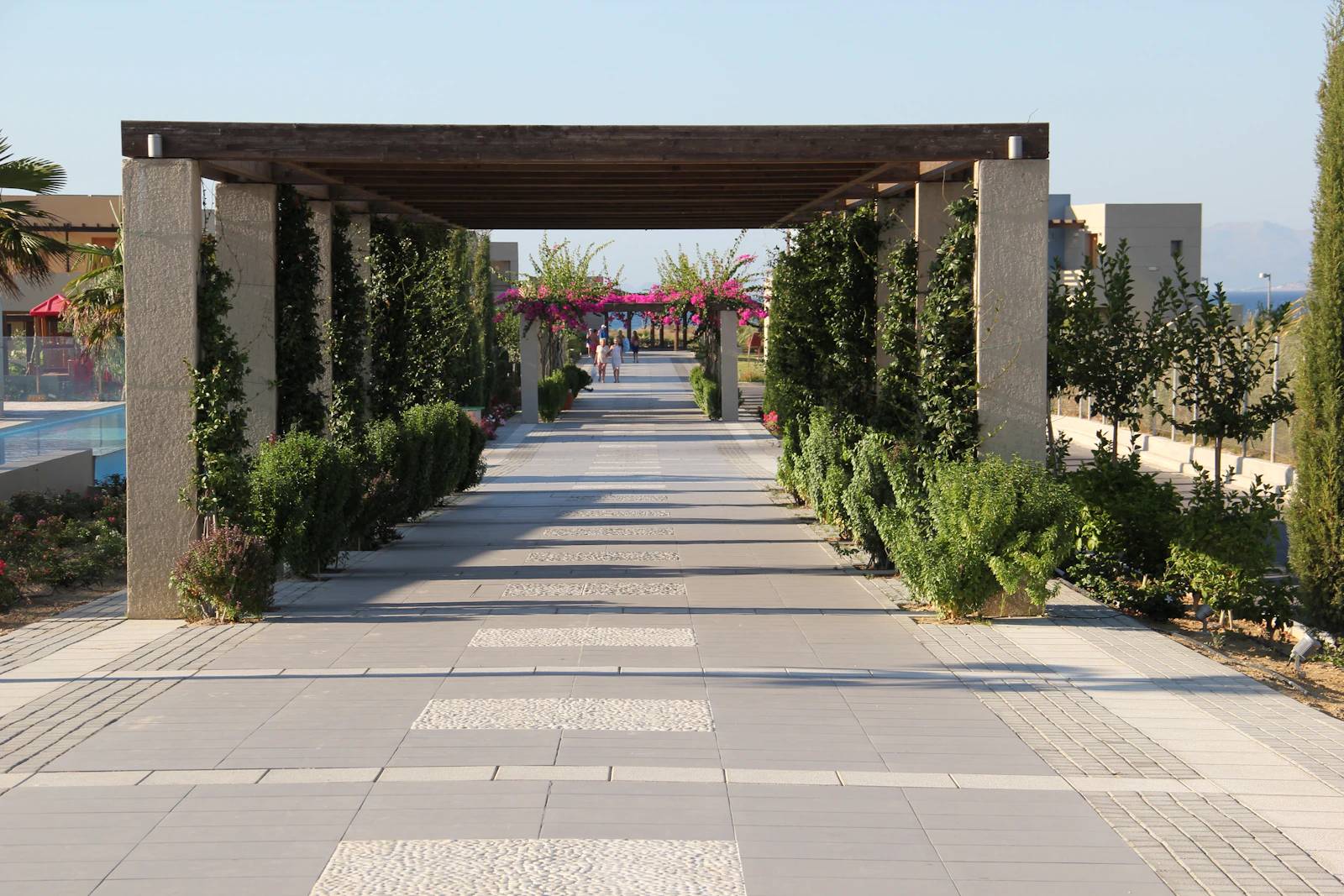
Beyond pool decks, commercial landscapes encompass a wide range of outdoor surfaces — from the approach driveways of business parks and hotels to the pedestrian walkways threading through resort gardens and mall open courts. Each of these surfaces carries its own traffic profile, drainage context, and aesthetic brief.
For high-traffic pedestrian walkways exposed to constant wet-season rainfall, the priority is consistent texture across wide surface areas with reliable drainage. Aggregate systems applied in thicker, coarser profiles perform well here — the texture depth handles the volume of water typical of tropical downpours without creating standing water retention on the surface itself.
Driveway surfaces and vehicular areas require a different consideration: aggregate systems must resist the compressive and shear forces of vehicle traffic in addition to pedestrian use. Specifications for these zones should confirm the resin binder system's load-bearing rating and ensure adequate substrate thickness and reinforcement.
For outdoor commercial areas where vertical surfaces — boundary walls, planter boxes, retaining walls — adjoin the flooring system, product coordination becomes important. Exterior-grade wall coating systems like Opus, TechStone's sintered sand and polished concrete-look coating for exterior vertical surfaces, can be specified alongside Mineral Sand Flooring to create a unified material palette across both horizontal and vertical surfaces in the same landscape zone. Opus is engineered for outdoor facades and boundary walls, providing the weathering resistance needed to maintain a premium appearance across Philippine wet seasons year after year.
Explore TechStone's completed exterior and landscape work in our project portfolio for applied examples across hotel, resort, and commercial developments.
Maintenance Considerations for Long-Term Performance
Even the best-specified slip-resistant flooring system requires appropriate maintenance to sustain its safety and aesthetic performance. For Philippine outdoor commercial properties, a maintenance program should account for:
- Regular cleaning: High-pressure washing at the start and end of wet season removes accumulated organic matter and prevents algae establishment in surface texture.
- Periodic inspection: Annual visual inspection of aggregate bonding, surface profile, and substrate condition allows early identification of areas at risk of delamination or wear.
- Prompt repair of damage: Localized damage — from point loads, chemical spills, or substrate movement — should be repaired promptly before water ingress compromises the surrounding coating bond.
- Resealing where applicable: Some aggregate systems benefit from periodic topcoat resealing to restore UV resistance and surface cohesion. Follow manufacturer guidance on recoating intervals.
A well-maintained aggregate flooring system in a Philippine commercial context should realistically deliver 10 to 15 years of serviceable performance before major remediation is required — a strong return on the initial specification investment.
Specifying for Safety: A Checklist for Architects and Property Managers
When evaluating outdoor flooring systems for commercial projects in the Philippines, consider the following specification criteria:
- Wet COF rating: Request documented test data. Systems intended for pool decks and ramps should exceed 0.80 wet COF.
- UV stability: Confirm the binder system's photostability rating. UV degradation is a primary cause of premature failure in tropical climates.
- Substrate compatibility: Verify the system's compatibility with the existing or planned substrate — concrete, screeded floors, or existing tiles each require different preparation approaches.
- Drainage design: No flooring system compensates for inadequate drainage design. Ensure surface falls and drainage points are engineered to prevent water ponding.
- Installer credentials: Aggregate-based systems require skilled application for consistent texture and adequate bonding. Verify installer experience with the specific product system.
- Warranty and support: Premium coating systems should be backed by manufacturer warranty and local technical support — particularly important in the Philippines where post-typhoon remediation may be required.
Conclusion: Safety, Durability, and Design — No Compromise Required
The wet season in the Philippines is an annual stress test for every outdoor commercial surface in the country. Properties that have invested in properly specified, aggregate-based slip-resistant flooring systems will navigate it with confidence — their pool decks, walkways, and landscape surfaces continuing to perform safely and look exceptional regardless of how many millimeters of rain fall.
For architects, interior designers, property developers, and contractors working on commercial projects across the Philippines, the specification decision is straightforward: prioritize systems engineered for tropical outdoor performance, backed by technical data, and supported by experienced local applicators. The initial investment in quality specification pays dividends across the lifetime of the property — in safety performance, reduced maintenance costs, and the continued delivery of premium guest and visitor experiences that commercial properties depend on.
To explore TechStone's range of outdoor-rated flooring and facade systems, visit our Mineral Sand Flooring collection or speak with our technical team about specifying the right solution for your next commercial project.